“There is extraordinary confusion over what distinguishes Anglo-American conservatism from Enlightenment liberalism (or ‘classical liberalism’ or ‘libertarianism’ or, for that matter, from the philosophy of Ayn Rand). Indeed, for decades now, many prominent ‘conservatives’ have had little interest in political ideas other than those that can be used to justify free trade and lower taxes, and, more generally, to advance the supposition that what is always needed and helpful is a greater measure of personal liberty. And if anyone has tried to point out that these are well-known liberal views, and that they have no power to conserve anything at all, he has been met with the glib rejoinder that ‘What we are conserving is liberalism’, or that ‘Conservatism is a branch or species within liberalism’, or that ‘Liberalism is the new conservatism.’ For the most part, these comments are made out of ignorance, although on rare occasions it does seem as though there may be other motives involved. At any rate, it is now clear that this confusion concerning the content and purposes of political conservatism has paralyzed the conservative impulse in the English-speaking world, rendering it weak and ineffective. For the truth—which at this point cannot be repeated frequently enough—is that Enlightenment liberalism, as a political ideology, is bereft of any interest in conserving anything. It is devoted entirely to freedom, and in particular to freedom from the past. In other words, liberalism is an ideology that promises to liberate us from precisely one thing, and that thing is conservatism. That is, it seeks to liberate us from the kind of public and private life in which men and women know what must be done to propagate beneficial ideas, behaviors, and institutions across generations and see to it that these things really are done. To the extent that Anglo-American conservatism has become confused with liberalism, it has, for just this reason, become incapable of conserving anything at all. Indeed, in our day conservatives have largely become bystanders gaping in astonishment as the consuming fire of cultural revolution destroys everything in its path.”
—Yoram Hazony, Conservatism: A Rediscovery—
✦✦✦
Until very very recently in the history of American politics, conservatism saw its role as being to conserve classical liberalism. Which is to say that American conservatives did not regard conservatism as a philosophy in its own right, but saw conservatism as more or less a bodyguard tasked with protecting an Enlightenment project that was itself inherently liberal in its ambitions. (Which, in the 20th century, more or less devolved into a situation where conservatism became—in some ways—progressivism going the speed limit.)
Prominent adherents of this empty conservatism still saw plenty of political benefit, though, in riling up armies of religious, blue collar, rural Americans to be their loyal voters in exchange for empty promises of “economic prosperity” and “restoring traditional values”. Yet this conservatism’s true allegiance was always to the banks and corporations run by a class of elitist donors who hated religious, working class, rural Americans.
It was not uncommon for Republican politicians and their staffers to make demeaning remarks behind closed doors about constituents (often using terms like “redneck”, “crazy”, “hick”, “rabid”, and “dumb”), and voters at rallies whose hands were shaken and whose babies were kissed by conservative candidates, would—in a matter of hours—be betrayed by those same candidates when lobbyists showed up to buy dinner.
Thus, elected conservatives for decades were characterized by a willingness to lie to regular people about “wanting the same things they did”, all while facilitating the very things they promised to fight: unchecked immigration, globalization/outsourcing, gun control, economic recession/inflation, environmental degradation, higher taxes, indoctrination in public schools and universities, and the decimation of collective bargaining. Because, after all, what were these conservative politicians supposed to conserve? Not national identity, not the wellbeing of the family, not sound money or savings or thrift, and certainly not a shared sense of transcendent order. The conservative’s task—prior to the discourse shift in the mid-to-late 2010s—was to conserve only the classical liberal twin pillars of consumerism and individualism.
Up until very recently in the history of our politics, the only “genuine conservative” that was allowed to exist was a classical liberal. There was no identity on the Right that could be had apart from it.
I mean for godsakes, remember when these insufferable dweebs were considered the rockstars of American conservatism?
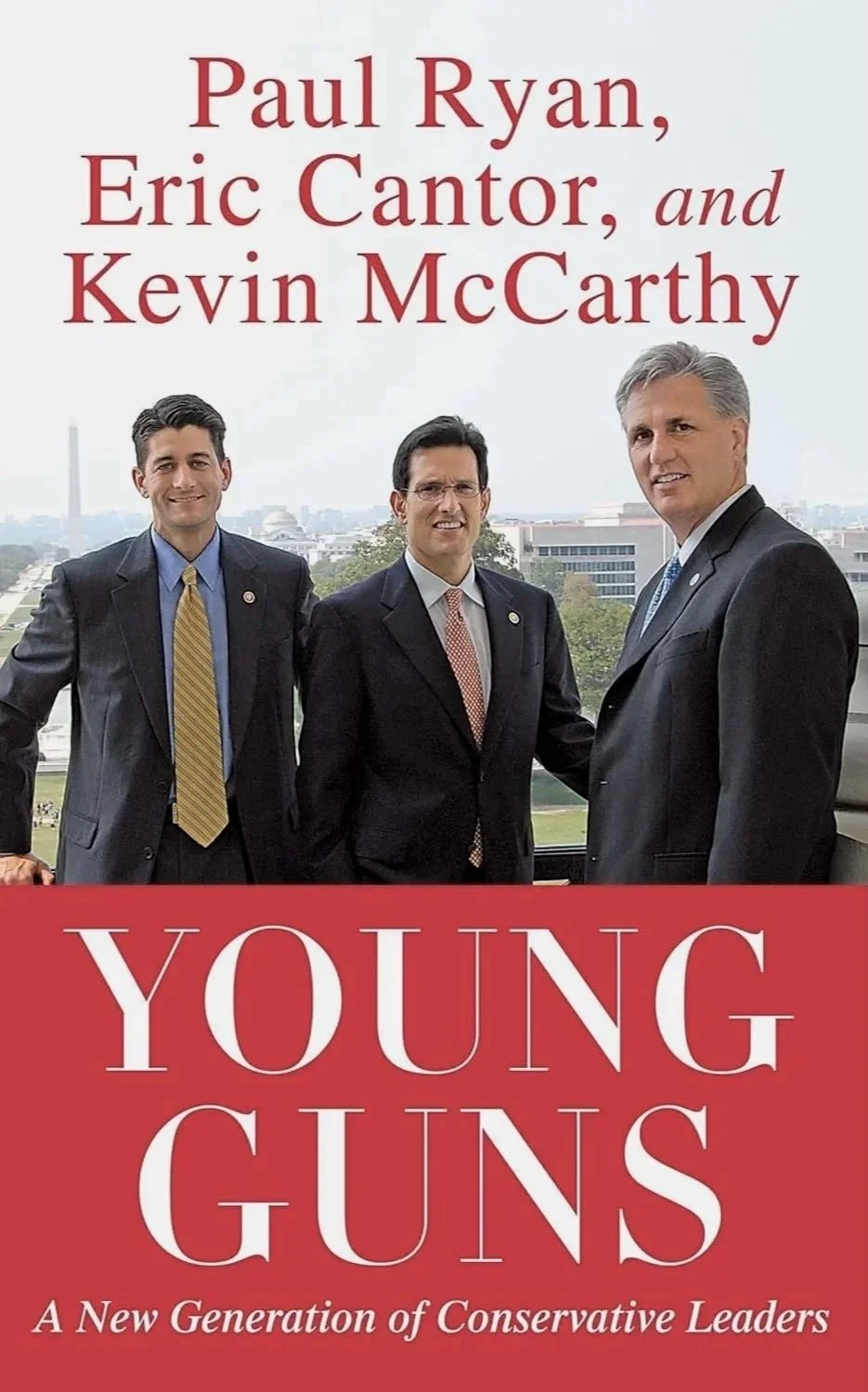
Eric Cantor was dubbed a “rising star” and “future president” by Politico and MSNBC until everybody was shocked that he lost his next primary, because people in his district were pretty vocal about their displeasure that he neglected his duties to them in favor of chasing a national spotlight. In a show of genuine contrition for ignoring his constituents—who had an average annual income of $37,000—“rising star” and “future president” Eric Cantor immediately went to work for a global investment bank after his loss; a bank that then and to this day specializes in helping corporations downsize.
Paul Ryan, whenever asked to identify his primary conservative influence, always responded with “Ayn Rand”, and was known to require prospective interns and staff to read Atlas Shrugged in order to work for him. Not content, however, with his worship of the bitter pseudo-intellectual ghoul being an ominous signal to the American public, Ryan later went on to opine to a crowd at CPAC that free school lunch programs gave children “full stomachs and empty souls”. For all this, major conservative publications like National Review and The Weekly Standard showered him with praise, calling Ryan “comparable to James Madison” and “a courageous standard-bearer who bears our standards”. This begged the question of what, exactly, conservative standards were: the dignity of the human person or “The children yearn for the mines!”
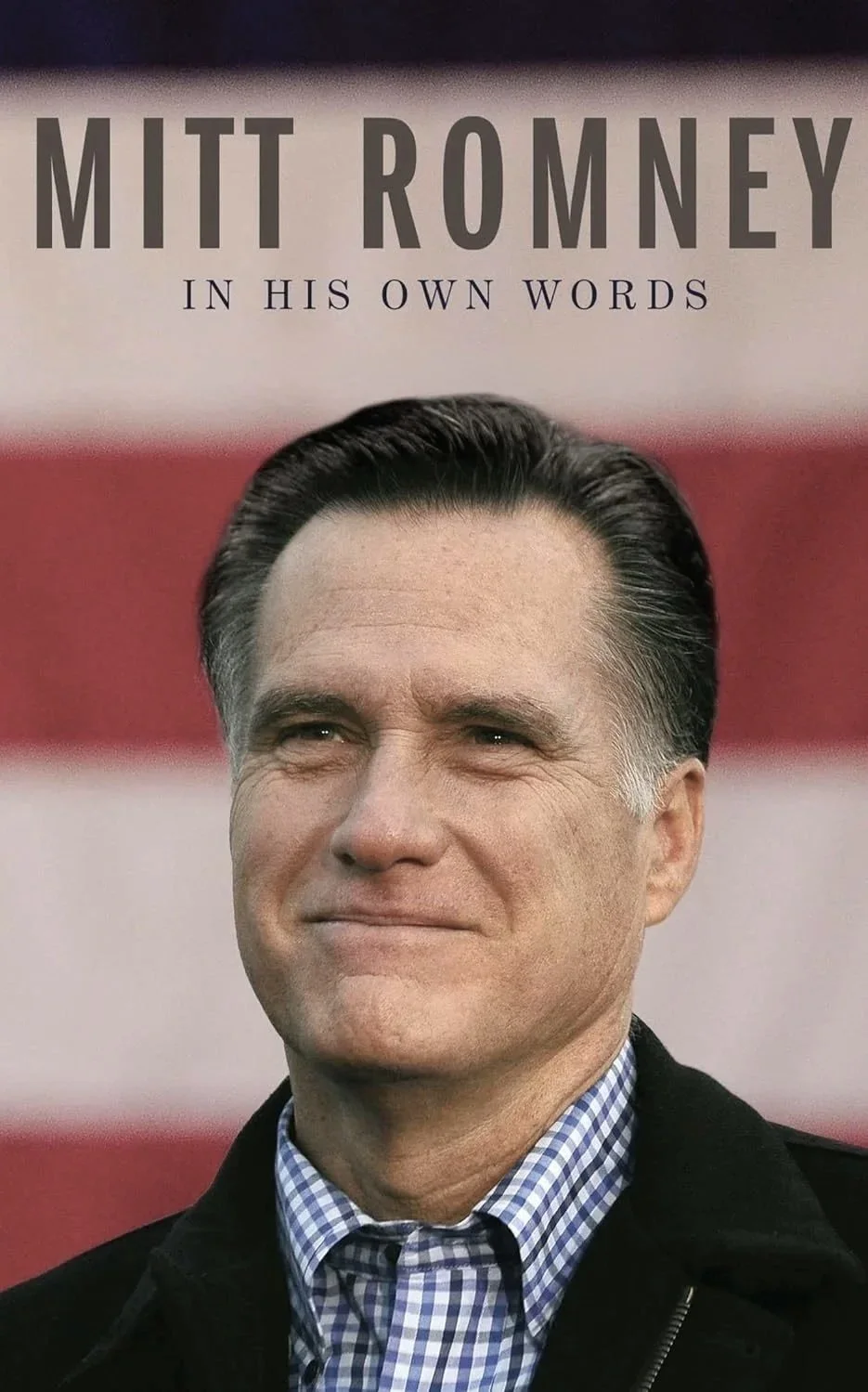
And finally Mitt Romney (the 2012 candidate for freaking President) famously said that 47% of Americans were “entitled” and “believed they were victims”, and went on to become embroiled in a scandal when it was discovered that—during his time as managing director at global investment firm Bain Capital—he utilized leveraged buyouts to lay off thousands of workers, cut wages, and close factories in exactly the states, counties, and small towns he was hoping would vote for him.
But it wasn’t just these hyper-capitalist anti-blue collar “rockstars” who represented everything wrong with a conservatism that considered itself a mere bodyguard for classical liberalism. For quite a few years after Romney’s election loss (roughly between 2012 and 2017), a cavalcade of “rightwing-but-quirky personalities” were super eager to display a complete abandonment of even the pretense of having traditional values:
“I’m a feminist conservative.”
“I’m a gay-married conservative who’s adopting kids.”
“I’m an atheist conservative.”
“I’m a conservative who believes in open borders.”
Those whose classical liberal convictions convinced them that conservatism was nothing but a combination of unregulated markets and nonexistent social policy, never seemed to stop and wonder if they weren’t just libertarians who said “soirée” instead of “party” and preferred bourbon to weed.
Not surprisingly, if ever you asked one of these self-proclaimed conservatives what history the classical liberal “conservative movement” was rooted in, almost invariably the farthest back they could trace for an origin would’ve been Edmund Burke. I’ve got no problem with Edmund Burke, Edmund Burke is swell, I’ve quoted Edmund Burke in past writings, but when your entire marketing ploy is that you represent stability, deep roots, inherited wisdom, “permanent things”, and the perennial tradition of the West, tracing yourself back only 300 years hardly keeps the suspicion of increasingly skeptical voters at bay.
But that was always what 20th and early-21st century conservatives acted like. It was as if, to them, Western civilization began in the 18th century. They voiced no thoughts about ancient Greece or Rome, no thoughts about the Jewish diaspora, no thoughts about Charlemagne or the Middle Ages, no thoughts about the Battle of Lepanto, no thoughts about the Reformation or Counter-Reformation, no thoughts about any aspect of Western history prior to the 1700s. Anything of relevance in terms of both the philosophy of governing and the philosophy of the human person began for them (at the earliest!) with Edmund Burke and the Enlightenment world in which he lived.
Thus, when the term “postliberal” is used in the context of differentiating its brand of conservatism from the “conservatism” previously described, it’s important to understand that this word is not referring to the liberalism we might think of when we hear the terms “liberal Democrat” or “flaming liberal”, but rather when the term “postliberal” is used, it is referring to “liberal” as in the classical liberal worldview that was created, shaped, and developed from the time of the Enlightenment all the way to the sexual revolution of the 1960s.
To be a “postliberal” conservative, then, is to be someone who seeks to rediscover and excavate a conservatism that emerges from a deeper strata of Western civilization—pre-Enlightenment—and draws legitimacy from a more ancient and teleological epistemology beyond and apart from the classical liberal framework that gave birth to the fake conservatism you and I have been exposed to for practically our whole lives.
Now, I’ve made it clear before in other writings that—in watching (as we all have) the breakdown of public order and the accelerating decay of our institutions—I think the United States is headed for almost certain economic and societal collapse, even if Trump’s reelection offers a momentary reprieve.
But I also think there’s still one way America can avoid this fate, and that “one way” is nothing less than a national awakening to postliberal conservatism. So… what are the foundational tenets of postliberal conservatism, and what really makes it so different from the other “conservatism”? Grab a coffee or a snack, because this essay’s gonna be lengthy.
=★=
To clarify, no American should completely hate the Enlightenment. Nor express anything but gratitude and admiration toward America’s founding fathers, who, though enthusiasts of the Enlightenment, were brilliant men who risked their “lives, fortunes, and sacred honor” to establish our great country. The freedom to worship according to our conscience, the freedom to speak our deepest convictions, and the freedom to own weapons to protect ourselves are all freedoms that would have been scoffed at in the pre-Enlightenment world.
But liking some concepts of the Enlightenment, and recognizing that the existence of an independent United States is owed in large part to the Enlightenment, does not obligate us to support the Enlightenment whole hog. As big a boon as it was in some ways to Western civilization, the Enlightenment took from people as much as it gave. It took away our sense of duty toward others, it took away our sense of the holy, and more broadly it took away a shared moral vocabulary; which then, of course, had downstream effects where we no longer felt bound to uphold marriage, children, care for the elderly, or civic life, and as a result now suffer from an epidemic of loneliness, anxiety, and depression.
The spiritual destitution of the classical liberal framework is that it is unable to conceive of any morality beyond possession, any higher law than property, any duty beyond non-aggression, any obligation that is not slavery, any bind that is not a chain, or any relationship at all other than ones which can be slapped with the labels “ownership” or “subjugation”. In its obsession to not become a tyrant of the body, it’s become tyrant to the soul.
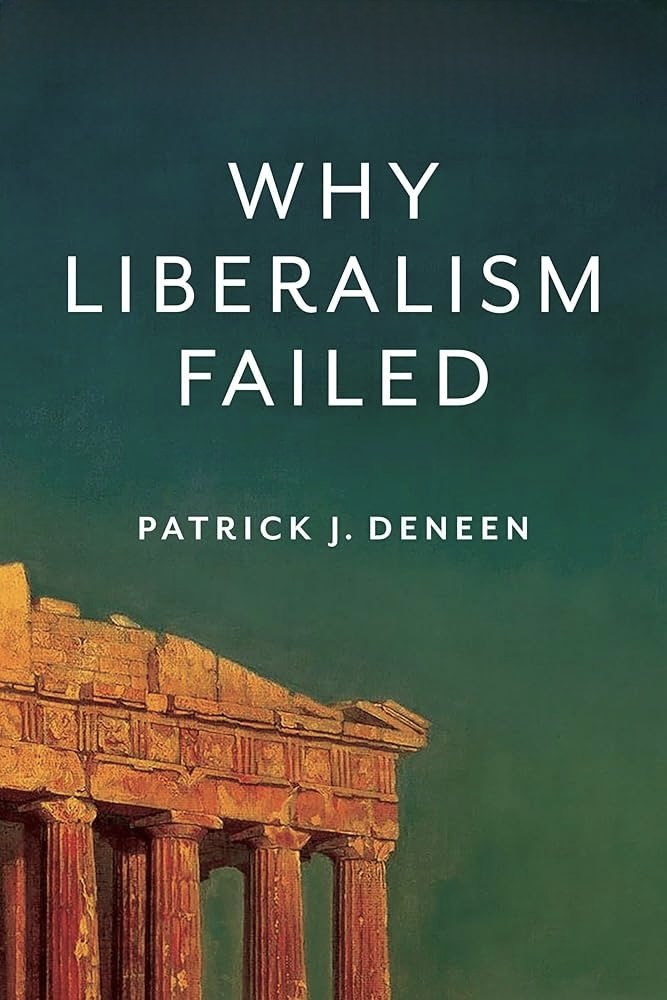
As political theorist Patrick Deneen put it in his 2018 book Why Liberalism Failed:
“Classical liberalism often claims neutrality about the choices people make in liberal society; it is the defender of ‘rights’, not any particular conception of the ‘good’. Yet it is not neutral about the basis on which people make their decisions. In the same way that courses in economics claim merely to describe human beings as utility-maximizing individual actors, but in fact influence students to act more selfishly, so classical liberalism teaches a people to hedge commitments and adopt flexible relationships and bonds. Not only are all political and economic relationships seen as fungible and subject to constant redefinition, so are all relationships—to place, to neighborhood, to nation, to family, and to religion. Classical liberalism encourages loose connections. […] In this world, gratitude to the past and obligations to the future are replaced by a nearly universal pursuit of immediate gratification: culture, rather than imparting the wisdom and experience of the past so as to cultivate virtues of self-restraint and civility, becomes synonymous with hedonic titillation, visceral crudeness, and distraction, all oriented toward promoting consumption, appetite, and detachment. As a result, superficially self-maximizing socially destructive behaviors begin to dominate society.”

Going forward, I’ve decided to start calling classical liberal conservatism “Boomer/Reagan conservatism”. Not because classical liberal conservatism began with the boomer generation or began with Ronald Reagan (it was obviously around long before either), but because whenever I hear people claiming to be conservatives who are defending classical liberal principles against traditionalist critiques, those people are almost always boomers and almost all of them will tell you (with nostalgia welling in their eyes) that the Bestest President Ever Of All Time was Ronald Reagan. So… just to poke fun a bit, from here on out “Boomer/Reagan conservatism” will be the moniker I use when describing classical liberal fake conservatism.
A decent outline comparing policy differences between Boomer/Reagan cons and postliberals can be summarized as follows:
Boomer/Reagan Conservatism
Sees liberty as an ultimate good in itself. It is not what one does with their liberty that matters; only that a person has liberty. Liberty, thus, is identified as an independent good rather than a mere vehicle by which to achieve good.
Sees “free markets” as an independent good. The impact, positive or negative, of free markets on society are a secondary consideration to said society’s “consistent prioritization of freedom” for good or ill. Hence, if the Invisible Hand of the Market moves all the jobs overseas and hikes interest rates for mortgages, then that’s simply the market’s will and must be accepted.
Is quick to hold up its hands defensively and claim “I don’t have a problem with legal immigration, only illegal immigration.” As if prospective migrants merely not submitting the correct papers in the correct order is the problem with mass immigration. As if certain third world cultures don’t have values that are fundamentally incompatible with Western cultures, and which make any form of cohabitation chaotic and dangerous (e.g. Somalis in Minnesota).
Associates power with restraint, because “restraint is a conservative impulse”; views members of the opposition not as a Fifth Column who have a deep-seated hatred of America and the West, but as “esteemed colleagues” with small differences of opinion who can be reasoned with. In no time flat, politicians of this persuasion—who voters expected would exercise power to achieve desired outcomes—very quickly begin lecturing their disappointed electorate about “the power of compromise”.
Intuits no connection between degenerate and ugly architecture, art, and literature to the political and moral character of the populace. Politicians of this stripe then find themselves befuddled when a public who’s used to soulless skyscrapers, weird sculptures, and woke contemporary fiction doesn’t vote for the Norman Rockwell vision of America not even they themselves believe in.
Views the Constitution as an almost sacred document and the “highest law”; one that should rarely be amended, and should be interpreted according to whatever the original intent may have been when the founders wrote it (even if the assumed original intent of certain articles and amendments wind up being detrimental to a society that’s very different from the one the Constitution was written in). When attempting to stop criminals and terrorists, Boomer/Reagan cons refuse to violate the Constitution in order to do so, which often results in delay or absence of justice. Over time this leads to a government that holds the twisted perspective that the less frequently vicious thugs are punished, the more “righteous” the state is for “going by the book even when it’s inconvenient”. Righteous government, then, is not defined by producing outcomes beneficial to the public, but by a strict adherence to rules even to the public’s detriment.
Having blind fealty to the Constitution, and being constrained by the freedom of religion clause of its First Amendment, Boomer/Reagan cons are forced to pretend that all religions are inherently benign and none are inherently threatening. When followers of certain religions commit terror attacks or violate laws, they’re labeled as “extremists” rather than people merely doing what their texts or founders teach them to do; because if banning the practice of certain religions is “unconstitutional”, then the only alternative for Boomer/Reagan cons is to cater to nominal adherents while trying to label those who are genuinely faithful as “extremists”. (In this way, Boomer/Reagan cons demonstrate a willingness to propagate a false picture of reality just for the sake of Constitutional compliance.)
Postliberal Conservatism
Sees liberty as a means to an end. A tool to be used in pursuit of what is actually ultimately good - virtue. Our emphasis is on duties rather than on rights, because we recognize that rights are inherently neutral not inherently good.
Markets are a tool to generate prosperity for the citizenry. The extent to which economies are allowed to be “free” or planned wholly depends on how these varied markets benefit the citizenry at any given time. Economic protectionism, then, is not considered a verboten notion, but on the contrary is seen as necessary for supporting the public (which is a higher good than “market freedom”).
Even legal immigration should be curtailed if the number of immigrants arriving threaten the cohesion of society; and further, immigration from specific countries should be prohibited entirely (without apology or justification) if the inhabitants of those countries consistently display hostility toward the West and our way of life. Immigration is a privilege, not a right, and the state should be able to grant and rescind that privilege at any given time.
Not afraid to use power to achieve desired outcomes, no matter how loud the outcry from opposition. (Because the opposition is not merely thought of as “opposition”, as if in a sporting event, but instead is rightly perceived as evil.) The responsibility of political power, then, is not “restraint” or “compromise”, but rather the responsibility of political power is the establishment of public order, increasing the prosperity of the common man, and the competent execution of justice.
Understands that architecture, art, and literature are as important, if not more important, than politics. Promotes a revival of gothic, neoclassical, romanesque, and art deco architecture; a rejection of relativist and disgusting “art” in favor of aesthetically pleasing art conveying moral/mythological themes; and a celebration of literature published outside of big publishing companies captured by leftist women.
Does not view the Constitution as “sacred”, and further points out that the Constitution’s foundational liberal principles have ultimately failed to foster a virtuous society. Thus, postliberalism is willing to amend or repeal parts of the Constitution (even often), if doing so is good for the country.¹ The highest law is Natural Law, which at times may be in agreement with the Constitution and at other times may conflict. A postliberal conservative government would also be willing to suspend the Constitution in times of obvious national emergency, especially when it comes to domestic enemies; seeking to avoid—to quote Nietzsche—“The point in the history of society when it becomes so pathologically soft and tender that among other things it sides even with those who harm it.” (In sum, postliberal conservatives realize that a government which cannot make exceptions to its own rules in a genuine crisis should be replaced by a government that can.)
Having no blind fealty to the Constitution, a postliberal conservative government would revise the First Amendment, reserving religious tolerance only for religions that don’t have a track record of disrupting societies; banning the practice of demonstrably wicked faiths like Islam, Satanism, Satanic-adjacent folk religions, Scientology, and polygamous cults.² Adherents of peaceful faiths (like Hinduism, Sikhism, and Buddhism) are welcome to worship and be our neighbors, but only if they acknowledge the Judeo-Christian heritage of the West, never try to subvert it, and are willing to live as permanent minorities. In addition, atheists are free to practice no religion and welcome to live with us as neighbors, but cannot hold public office at any level. (Entailing the further revision of Article 6, Clause 3.)
All of these policy differences amount to a major philosophical difference: “small government” republican-democracy versus effective government regardless of form. Boomer/Reagan cons believe that small government republican-democracy is the goal. They believe this because—again—if the task of conservatism is supposed to be the preservation of classical liberalism, and the core of classical liberalism is the freedom of the individual and of finance, then the only way to free the individual from any social or familial obligation and to free finance from accountability is to shrink the size of the enforcing state.³
By contrast, to postliberal conservatives, neither the size nor system of government really matters all that much, and the bottom lines of corporations and “freedoms” of the atomized individual are not what law and society should be oriented toward. Instead, the form of government is a secondary concern, as long as whatever government that’s in place encourages goodness, truth, and beauty, and enforces order and justice. In any civilization worth preserving, goodness, truth, beauty, order, and justice should rank above an individual’s “total autonomy” and the unrestricted accumulation of capital. (Especially when we come to understand that one’s identity and sense of worth is not—as modern pop therapy would have us believe—derived independently and “from within”, but rather one’s identity and sense of worth is derived from interaction with the culture and nation around them, and one’s ability to contribute and assimilate into that culture and nation. Hence, putting the flourishing of the culture and nation before the flourishing of the individual in turn actually helps the individual.)
It’s possible to have a small government in a democratic-republic that allows every form of debauchery and turns a blind eye to crime and the demoralization of its populace. It’s also possible to have a larger government ruled by an autocrat who—despite the loaded label—cares for his people and rules with wisdom. Yet the Boomer/Reagan con is still forced to support the former government over the latter, even while society crumbles around them, because they’ve made belief in classical liberal ideas (small government and democracy) defining features of their fake conservatism.
Of course, there are plenty of historical examples of one-man rule going horribly wrong, and this is why postliberal conservatives do not specifically endorse one-man rule or any form of government exclusively; it is only that, in being flexible as to which form of government is best for a people at any given time, we are more open to the possibility that certain social or economic circumstances can exist where one-man rule becomes appropriate and good.⁴ We don’t look with suspicion at Plato’s “philosopher king”, and presume that we are so much more enlightened because we have apps and lattes.
But regardless of how one may feel about autocrats, postliberal conservatism isn’t about promoting autocracies or monarchies or any specific government structure; it’s only about not being wedded to the idea of “small government democracy no matter the cost”. Whereas Boomer/Reagan conservatism is stalwart about mechanisms but lenient about the values those mechanisms sustain, postliberal conservatism is lenient about mechanisms but stalwart about values. Postliberal conservatives want a nation and culture where the building of magnificent synagogues and cathedrals is prioritized, where communities are stable and multigenerational, where stories are told about heroes rather than victims, where virtue and beauty are taught and shame exists for things that should be shameful, where the lives of a majority of citizens are more agrarian and rural (rather than urban and technocratic), and where neighborhoods are bursting at the seams with thriving single-income nuclear families. If a democracy can lead to that, great. If an autocracy can lead to that, great. If a congress can lead to that, great. If dissolving congress can lead to that, great. We don’t care how things get done, only that they get done.
This major difference in philosophy of government between the Boomer/Reagan cons and postliberals is rooted in an even greater difference—a difference so fundamental and monumental that, more than any of the aforementioned differences, it’s the one that most radically changes the entire course of both’s political pursuits—and that difference between the two camps is a difference of metaphysical presupposition.
Boomer/Reagan cons have been conditioned to see the individual as occupying the center of his very own ontological and spiritual universe. “Man is endowed by his Creator with certain inalienable rights: among these are life, liberty, and the pursuit of happiness.” And while such a statement at the beginning of our Declaration of Independence is not bad per se, notice how it centers man and not the Creator. The Creator, in this sentence, is merely the prompt that sets man up for a life of chasing his own desires. G-d is the winder and we the wind-up toy, and once we’re wound up, G-d gets out of the way as we bash our cymbals wherever we please. While “Man is endowed by his Creator with certain inalienable rights: life, liberty, and the pursuit of happiness” would not necessarily be objectionable as an isolated statement situated in a longer treatise about moral duties, its existence in a declaration of independence (focused on rights) caused it to take on a deistic ontology that fueled classical liberal philosophy, and by extension, American political discourse (progressive and “conservative”) for the past 250 years.
Postliberal conservatism by contrast sees each individual as existing at the periphery of a divine cosmic plan that they—as individuals—are free to participate in (as members of families and nations), but not direct, and certainly not as their lonesome entitled selves. Postliberal conservatism rewrites “Man is endowed by his Creator with certain inalienable rights: life, liberty, and the pursuit of happiness” as “The Creator [placed first] endows man [placed second] with certain blessings and tasks: life as long as ordained, liberty of conscience, and the pursuit of virtue”; recognizing 1) that “liberty” amounts to nothing when detached from divine purpose and the reasonable expectations of family and society, and 2) that happiness is a nebulous and fleeting sensation—not too dissimilar from being hungry or gassy—and has little or nothing to do with the lasting joy that comes with the sacrifice, self-denial, and formation needed in order to shape good men and women.
At this point the objection is often raised, “If classical liberal ideals are what you’re challenging, then what exactly is it about Western civilization that’s worth saving?” This rhetorical question by Boomer/Reagan cons reveals a poverty of understanding regarding what a civilization is supposed to be.⁵ For when we talk about saving a civilization, it is not merely about preserving this ideal or that, but about preserving buildings and monuments and paintings and literature and music which all collectively through their respective communicative power transport us beyond mere ideals to a sublime and celestial transcendent; a divine presence, saturating the whole of the universe with His greatness, whom we cannot comprehend or conquer, but can only stand in awe of, and in standing in awe of, not only find our contentment but find purpose for our nation. That is—at root—what saving Western civilization means: restoring an awareness of the grandness of our collective societal story situated within an even grander story. And postliberal conservatism is the only conservatism that understands this. To the postliberal, saving the West means to declare to the rest of the world, “We build up our immaculate civilization now as a tribute to and a foretaste of the total renewal of all creation to come.”
In asking, then, “What about Western civilization is worth saving if not classical liberal ideals?” the Boomer/Reagan con reveals that they are—at heart—humanistic.
And in laying aside some of the ideals conjured by Enlightenment modernity in pursuit of more ancient and spiritual wisdom long buried and scorned, postliberal conservatives reveal that they are—at heart—messianic.
The postliberal conservative emphasis on governing according to a divine cosmology compliments an innate feature of human nature to ask about G-d, as Rabbi Joseph Soloveitchik asked in his 1965 work The Lonely Man Of Faith:
“Who is He who trails me steadily, uninvited and unwanted, like an everlasting shadow, and vanishes into the recesses of transcendence the very instant I turn around to confront this numinous, awesome, and mysterious ‘He’? Who is He who fills us with shock and bliss, humility and a sense of greatness, concurrently? Who is He to whom Adam clings in passionate, all-consuming love and from whom he flees in mortal fear and dread? Who is He who fascinates Adam irresistibly and at the same time rejects him irrevocably? Who is He whom we experience both as mysterium tremendum and as the most elementary, most obvious, and most understandable truth? Who is He who is deus revelatus and deus absconditus simultaneously? Who is He whose life-giving and life-warming breath we feel constantly and who at the same time remains distant and remote from all?”
This vocalized primordial religious impulse forms the foundation of the teleological development by Aristotle, Thomas Aquinas, and Rabbi David Novak that if G-d created reality with order, and that order includes human nature, and human nature implies Natural Law, and Natural Law lays out a clear framework of civic and personal virtue, and political communities exist to cultivate virtue (not just via the state but via mediating organic institutions), then the telos of politics is that it must support the conditions that produce virtuous people in order to sustain a civilization that coheres with reality instead of combats it.

And by this, I don’t mean that postliberal conservatism wants to institute theocracy; like modern-day Iran or Saudi Arabia or the 17th century Puritan colonies. Absolutely not. The founding fathers were wise to insist that American government should not represent or favor one denomination or sect of a religion to the exclusion of its close kin. No, by “governing according to a divine cosmology”, I only mean that postliberal conservatism recognizes secularism as not being inherently neutral but inherently atheistic, and by being inherently atheistic, secularism predisposes itself to godless conclusions and hollow anti-human outcomes. Postliberal conservatives, then, would seek to institute a government that is unafraid of having broadly Judeo-Christian reasons for doing things.
“We’re passing environmental laws to protect forests, rivers, and mountains because we believe this is what G-d wants.”
“We’re using a portion of taxpayer money to house homeless veterans because we believe this is what G-d wants.”
“We’re mandating six months’ paid maternity and paternity leave because we believe this is what G-d wants.”
“We’re providing free healthcare to all of our citizens because we believe this is what G-d wants.”
“We’re putting rapists and pedophiles to death because we believe this is what G-d wants.”
“We’re only giving marriage licenses to male-female couples because we believe this is what G-d wants.”
“We’re cracking down on pornography, strip clubs, and prostitution because we believe this is what G-d wants.”
“We’re recognizing the right of every worker to form or join a labor union because we believe this is what G-d wants.”
Even using “G-d wants” as a basis for legislation though, this kind of government—neither secular nor theocratic, but very basic in its Judeo-Christian expression—wouldn’t be a government that goes looking for wrongdoings like a Victorian nanny with a swatting-switch. Liquor stores would stay open, casinos would stay open, nightclubs would stay open, boyfriends and girlfriends would still live together, and there would still be house parties and spring break and general teenaged/college mischief. A postliberal conservative government—though treating some transgressions with a severeness currently lacking from the secular state (e.g. adultery, public drug use, graffiti)—would still exercise prudence in knowing where to enforce a better way and where to do nothing; understanding that most vices should not be considered crimes and that whatever goes on in the privacy of one’s home should, for the most part, stay private and be of none of the government’s concern.
Usually at this point, whenever a postliberal dares to suggest that it’s possible to have a Judeo-Christian government without being a full-on theocracy, moderns of both the Boomer/Reagan con and progressive stripe will come crawling from every corner like a horde of ravenous spiders touting the “irreversibility of time”. But by “time”, they do not mean the linear objectively real time of past, present, and future, but rather they mean the secular classical liberal political goals they’ve achieved in the past three centuries which they believe—by virtue of their having achieved them—are synonymous somehow with the advance of time itself. Thus, classical liberals conclude that any effort undertaken by postliberals to change civilizational course is doomed to be defeated by the “Arc of History” (notice the same dependency on “the Arc of History” as we see with the “Invisible Hand of the Market” to iron out any resistance).
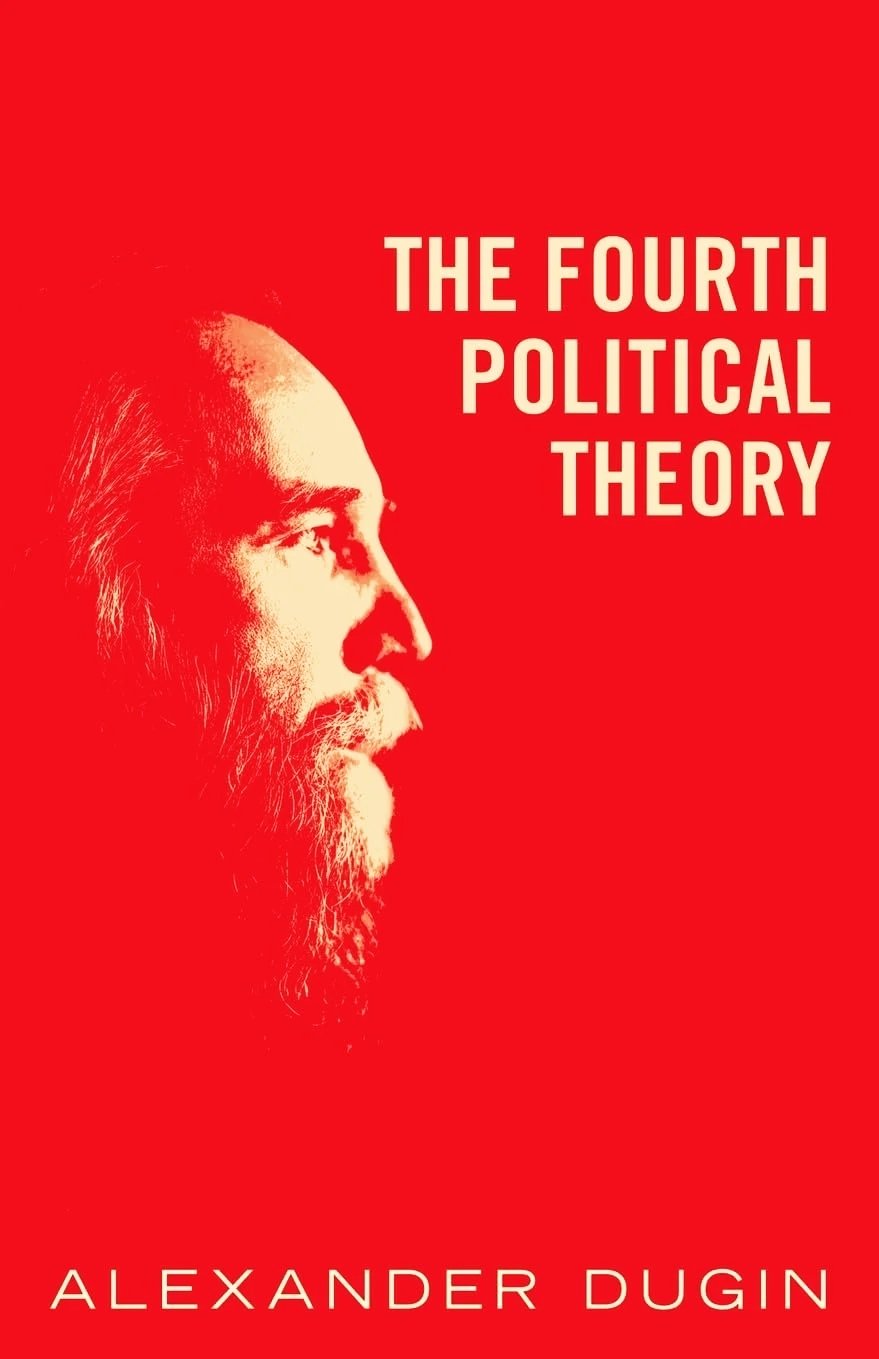
The Russian political philosopher Alexander Dugin⁶ criticizes the ridiculous notion that ideas are somehow the products or mandates of periods of time, rather than retroactively reinterpreted as “inevitable”, when he writes in his 2012 book The Fourth Political Theory:
“Theological constructions, antiquity, caste, and other aspects of traditional society, along with socialism, Keynesian theory, free markets, parliamentary democracy, or nationalism, are simply forms. But they are not related to an implied topography of objective time.”
Which means that when postliberal conservatives encounter the argument of the “irreversibility of time” or “Arc of History”, we shrug our shoulders, because we know that anything and everything is up for grabs at anytime. Just as nothing in the 18th century prevented people who were living in Judeo-Christian environments from embracing more secular systems of governance, so nothing in the 21st century prevents people who are living in secular environments from returning to Judeo-Christian governance. Nothing about living in the 21st century prevents us from recognizing that the best political order is one that aligns itself with eternal truth, hierarchy, and objective standards of beauty rather than relativistic secularism, egalitarianism, and materialistic individualism. We can still embrace a return to Natural Law, tradition, and the common good in the age of apps and lattes.
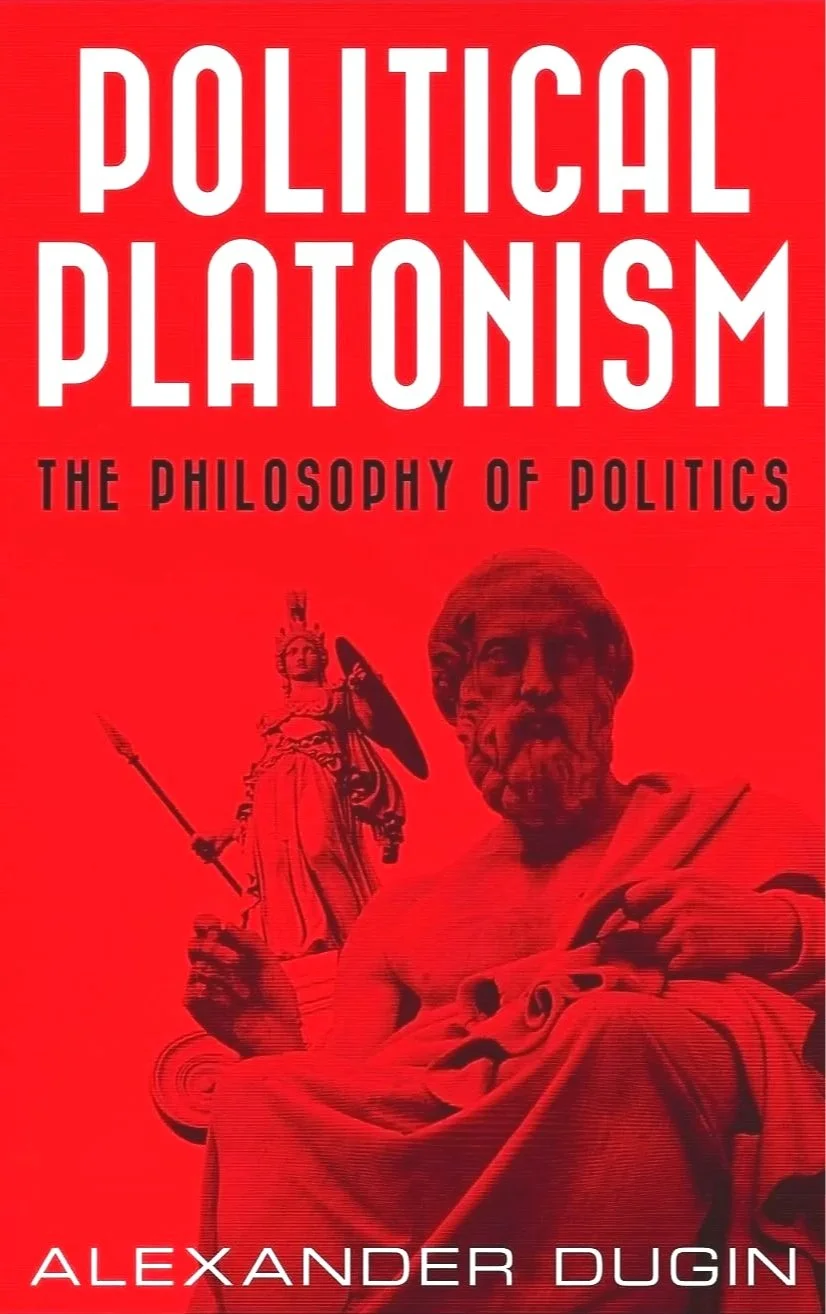
And in fact, even if one conceded that “the times” could—on their own—“demand” anything, surely the groanings and dissatisfaction coming from large portions of millennials and Gen Z would seem to indicate not a widespread desire to accelerate consumerism and atomization, but the opposite. For as Dugin notes in his 2019 book Political Platonism:
“Liberal democracies, through their false pretensions, conceal beneath themselves something else, but something in any case very bad, unjust, and unhealthy; for instance, a secret oligarchy or disguised tyranny. […] And today, more and more people are coming to the conclusion that humanity is not at all moving down the path it ‘should’ be moving down, and that the promises of progress, development, and universal enlightenment have proved false or altogether unattainable. A hundred years ago a majority of people looked into the future with optimism, awaiting a transition to something better, in some sense guaranteed by the ‘logic of history’. Today an entirely different mood prevails in societies: if it isn’t directly apocalyptic, it is at least skeptical regarding the ‘unrestrained burst of humanity forward into progress and enlightenment’. Although technical development continues at full speed, this does not affect human happiness directly at all, does not guarantee any moral or spiritual heights, and does not increase justice in the social order.”
History doesn’t have agency, civilizations do. Classical liberalism is not synonymous with destiny itself, and if Americans so decide, we can chart an entirely different course. One that values rootedness over rootlessness, duty over autonomy, beauty over utility, and meaning over comfort.